
- Start
- Narrating the governance of urban resilience
- Urban Resilience in the age polycrisis
- National urban development policy (NSP) as a reflexive governance approach
- Tracing narrative futures
- Bird’s Eye: The reflexive governance of urban resilience
- Deep Dive I: Narrative shifts on the programmatic and platform level
- Deep Dive II: Narrating resilient futures in three pilot projects
- Changing futures, changing narratives
- Resilience as a vision, resilience as a policy
- Narratives of crisis and transformation
- About the author(s)
- References
Published 25.03.2026
Narrating Resilient Urban Futures
Keywords: Narrative futures; urban transformation; resilience; reflexive governance
Abstract:
Crises and adaptation have long been topics of thinking about the future, and urban futures are no exception. By applying a narrative lens, we investigate how future visions of resilient cities have changed in the context of the Nationale Stadtentwicklungspolitik (national urban development policy) in Germany after the COVID pandemic. By combining qualitative and quantitative computational analysis of key documents and case studies of pilot projects, we show that the rise of the resilience topos has reinforced prevalent narratives of co-production and collaborative urban transformation. These narratives reflect principles of reflexive governance which have been proposed as an approach to govern fundamental uncertainty in the context of transformation research and practice. They preserve the utopian vision developed in the 2020 New Leipzig Charter and at the same time blur distinctions between present and future into a process of constant urban transformation.
Narrating the governance of urban resilience
Crises and adaptation have long been topics of thinking about the future, and urban futures are no exception. While multiple crises increasingly blur the distinction between present reality and apocalyptic future prospects, a policy shift towards (urban) resilience has been underway in recent years, catalyzed by the impact of the COVID pandemic. In this paper, we investigate how a rising sense of crisis and a focus on resilience is reflected in narrative futures – the narratives of actors in urban development about expected, desirable or undesirable futures. As we are interested in the narrative translations between different levels of governance, we focus on the German Nationale Stadtentwicklungspolitik (NSP, national urban development policy), a platform for coordinating urban development policies across multiple levels of governance from federal policy down to individual cities that explicitly links policy with experimental projects in specific localities.
Narratives have emerged as a central analytical category in research on (urban) transformations, especially for understanding how actors make sense of complex and deep-structural change as well as uncertain futures (WBGU 2011). Very broadly defined, a narrative is the oral or written “symbolic presentation of a sequence of events” (Scholes 1981: 205). In the context of governance and policy, narratives do not simply reflect reality. They are performative, shaping understandings of what is possible, desirable, and legitimate (Di Giulio and Defila 2023). In this sense, narratives are implicated in both sense-making and strategy-making in governance processes (Gadinger et al. 2014). In the field of sustainability transitions research, a growing body of literature deals with questions of the extent to which specific forms of narratives question established social structures, create legitimacy and support for institutional change, and how they construct positive expectations and desirable futures (Leipold et al. 2023; Simoens et al. 2022; Smith 2007; Smith and Raven 2012; Wittmayer et al. 2019).
Linking narrative analysis and a focus on governance practice, we observe how narrative futures building around the concept of resilience are related to principles of reflexive governance which have been proposed as an approach to steering uncertainty in processes of societal transformation (Voß et al. 2006) and which, as we argue, are also deeply engrained in the NSP as a multi-level governance structure. In essence, we are interested in how the rise of the resilience topos has impacted governance approaches in the context of the NSP. We ask two main research questions:
- What shifts can be observed in narratives of urban development in the face of an increasingly uncertain and problematic future?
- How do these shifts translate through the different levels of the overall NSP governance approach – from the European and national policy level through the NSP platform down to the level of local projects?
We aim to better understand how representations of the future change, how guiding principles of planning and urban governance change against this horizon, and finally, how these shifts are picked up and appropriated at the level of concrete local projects in the NSP framework. In the following, we will thus first provide an overview of core concepts – urban resilience, reflexive governance, narrative futures – as the basis for analyzing narratives in the NSP, tracing shifts on the programmatic and platform level as well as in three exemplary NSP pilot projects.
Urban Resilience in the age polycrisis
In the face of accelerating urbanization, growing security concerns and multiplying environmental crises, the concept of resilience has gained prominence in the discourse on sustainable urban development since the turn of the Millenium (Godschalk 2003; Jabareen 2013; Béné et al. 2018). While its modern understanding is rooted in ecology (Holling 1973), the concept has been adopted in the social sciences (Adger 2000) and social-ecological systems thinking (Folke et al. 2010). These perspectives have expanded the concept’s scope from a primarily buffering capacity to include the adaptive and transformative capacities of a system. While the former denotes internal change aiming to maintain an overall desirable state, the latter is about shifting into a new state in the face of challenges too great to be tackled within the current system’s regime (Béné et al. 2018; Cinner and Barnes 2019). Resilience can thus be defined as “the capacity to tolerate, absorb, cope with, and adjust to changing social or environmental conditions while retaining key elements of structure, function, and identity” (Cinner and Barnes 2019: 51).
Resilience has been widely adopted as a goal of urban development (Béné et al. 2018; Cinner and Barnes 2019). Sustainable Development Goal 11 explicitly aims to “[m]ake cities and human settlements inclusive, safe, resilient and sustainable” (UNGA 2015: 21), and the Resilient Cities Network unites cities from 46 countries under this common policy goal. Often, some form of abstract definition is adopted to the urban domain, e. g. “the ability of a city to withstand shocks and threats, to survive stresses and to adapt to social, political, economic and environmental change” (Monteiro et al. 2012: 113), while some scholars refrain from a common definition but embrace the multifaceted nature of resilience (ideal-typically in the compound concept proposed by Jabareen 2013).
In Germany, resilience has been acknowledged as an urban policy principle at least since the 2008 German Strategy for Adaptation to Climate Change (Bundesregierung 2008) which assigns spatial planning a leading role in creating resilient structures that are robust and flexible in the face of climate change and societal transformation. It has been mainstreamed in the urbanist discourse since the early 2010s, led by a variety of anthologies (e. g. Müller 2011) as well as special issues, for example by Informationen zur Raumentwicklung (BBSR 2013), which picked up on the resilience discourse in the face of a perceived multiplication of crises including the 9/11 attacks, the 2008 world financial crisis and the 2011 Fukushima catastrophe (Jakubowski 2013). Here, resilience is deemed both a necessary supplement as well as a prerequisite (ibid.) to the prevalent model of sustainable development (Greiving 2018). Resilience is also an overarching theme in the 2016 flagship report of the German Advisory Council on Global Change (WBGU 2016) focusing on sustainable urbanization. However, until recently, resilience as a concept did feature only passingly in the NSP policy program (e. g. BMVBS 2009: 10). This has changed since the wake of the COVID pandemic, when resilience has risen to the top of the urban policy agenda, most prominently with the Memorandum Urbane Resilienz (memorandum on urban resilience), prepared by an expert advisory board and published by the Federal Ministry of the Interior in 2021 (BMI 2021). At the same time, urban resilience has been picked up as the key theme for the 2020 project call Post-Corona-Stadt (post-corona city).
National urban development policy (NSP) as a reflexive governance approach
While resilience emerged only recently as a key concept in its context, the NSP has since its inception been conceived as an institutional framework for a collective learning process on urban development best practices (Hatzfeld and Jakubowski 2008; Beckmann 2020). Its core principles are grounded in lessons learned from the unintended consequences of incumbent planning paradigms, as well as experiences from the Städtebauförderung (urban development funding), and are tightly linked to the agenda-setting European Leipzig Charter documents. Since 2007, the NSP has evolved to include three distinct policy venues framed as pillars of the NSP: (1) experimental pilot projects in local urban settings, (2) a platform facilitating a constant dialogue among stakeholders, policy community and researchers and (3) applications of best practices, for example in funding programs or legislation (Weigel 2021). From a planning perspective, the NSP serves as an arrangement to facilitate the kind of innovative flow from specific episodes to processes and cultures that Healey (2004) has characterized as creative. Based upon the above characteristics, the core policy ideas behind the NSP can also be characterized as an attempt on reflexive governance.
Reflexive governance has emerged in the first decade of the 21st century as an approach to cope with uncertainty, non-linearity and reflexivity of societal modernization processes in the face of global sustainability challenges (Feindt and Weiland 2018). Building on the fundamental diagnosis that modernization itself has become reflexive (i. e. acting under conditions produced by prior modernization processes, see Beck et al. 1994), the concept, mainstreamed into sustainability discourses by Voß et al. (2006), argues for governance procedures and structures to become reflexive themselves – enabling feedback mechanisms, adaptivity and reflection of goals, means and solutions. As developed by Feindt and Weiland (2018), proposed approaches share the following four characteristics:
- integration of actors from various epistemic and practical backgrounds as well as levels of government,
- reflection and possible adaptation of underlying belief systems,
- openness towards alternative problem framings, and
- attempts to integrate multiple pathways towards solution.
Reflexive governance thus aims to transcend the entrenchment of specialized institutions as well as linear goal-oriented planning in favor of an integrative and open-ended collective search effort. It has been eminent in the context of societal transformation processes (Patterson et al. 2017), perhaps most prominently in Transition Management, focusing on governance innovations including experiments and integrated processes of knowledge production, goal formulation and implementation (Voß and Loorbach 2006; Voß and Kemp 2006).
This kind of integrative thinking has similarly been a central cornerstone of urban development best practices in Germany ever since the renaissance of integrated urban development in the 1990s (Beckmann 2018). Coping with the fallout of what can be interpreted as past modernization attempts (e. g. functional separation, large housing developments and processes of structural and demographic change) has been a central objective of national urban development funding in the context of the Städtebauförderung (Göddecke-Stellmann 2018). In redevelopment programs such as Stadtumbau Ost and Stadtumbau West (urban redevelopment east / west), integrated urban development has become a general prerequisite until 2010. It is also the central policy principle promoted in the Leipzig Charter of 2007, later complemented with place-based and co-productive approaches in the 2020 New Leipzig Charter. The NSP further builds on this and creates institutional arrangements for a participatory learning process, fueled by bottom-up experiments in different local contexts and aiming to distill and mainstream best practices in the face of an increasingly complex urban reality.
Tracing narrative futures
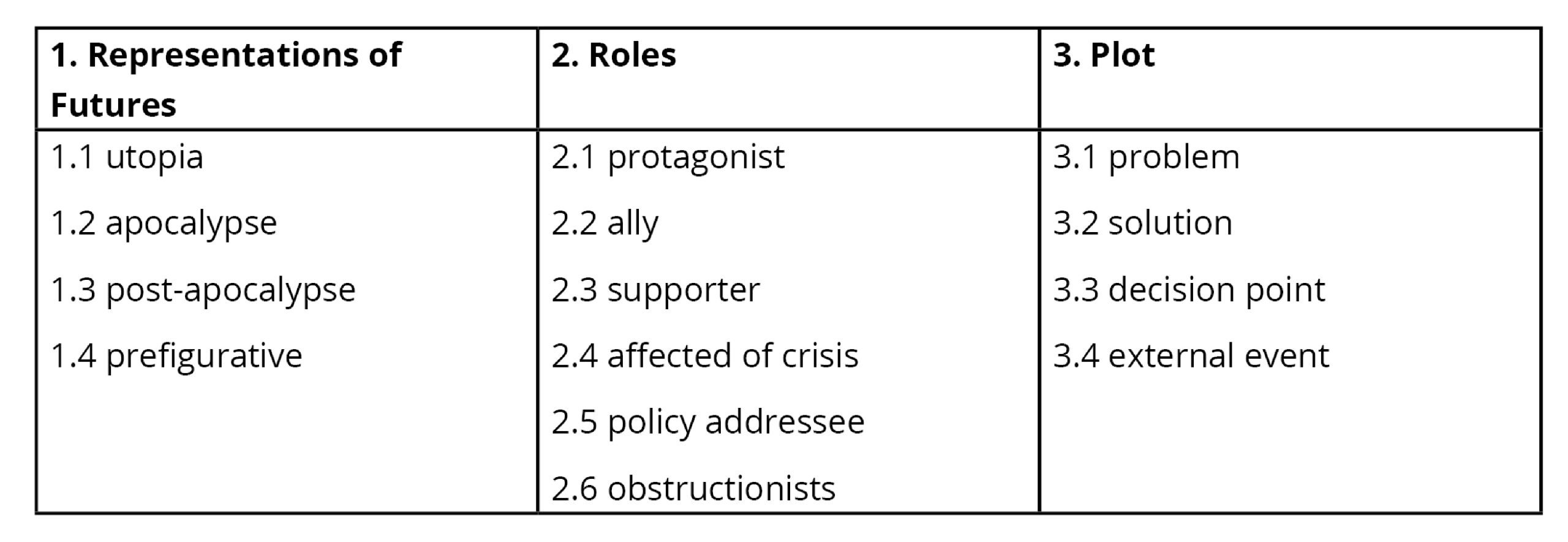
To understand the interrelations between resilience as a broader policy vision geared towards uncertain futures and reflexive governance as the strategy to achieve policy goals in the NSP context, we analyze expressions of narrative futures. Narrative futures entail different imaginaries of the future and temporal structures. We unpack them along three dimensions: First, we find representations of expected futures: apocalyptic futures (warning of future catastrophe), postapocalyptic futures (highlighting that we are already in the midst of the catastrophe), utopian futures (positive visions of a desirable future) and prefigurative futures (highlighting the cracks in the present where examples of utopian futures already exist) (de Moor 2022; Friberg 2022; Cassegård and Thörn 2018). Second, narratives about such futures are structured as plots – chains of events linking experiences and conflicts of characters in a temporal and spatial setting (Fischer et al. 2022: 14) – in which specific causal-temporal linkages of problems and solutions are constructed. As a third dimension, we focus on the specific roles assigned, such as the story’s protagonists and their supporting cast, in order to understand how and by whom resilient urban futures ought to be shaped.
We analyze narrative futures and how they shift across (1) the overarching programmatic level of core policy ideas that act as an orientation for the NSP as agreed upon at the national and European level, (2) the NSP platform, where urban development is discussed with the policy community and (3) the experimental projects funded and supported by the NSP. Within a text-analytical approach, we concentrate on textual data aligned along the main analytical axes of resilience as a topic and translations between the three levels (Table 1). We acknowledge that the NSP platform features a diversity of sites (such as discussions at the annual main conferences). However, for the sake of comparability, we narrow our focus to the textual representations of project calls and website portraits. Thus, we analyze how policy objectives have been translated to frame projects and how lessons from individual projects have been incorporated back into platform-level framing.
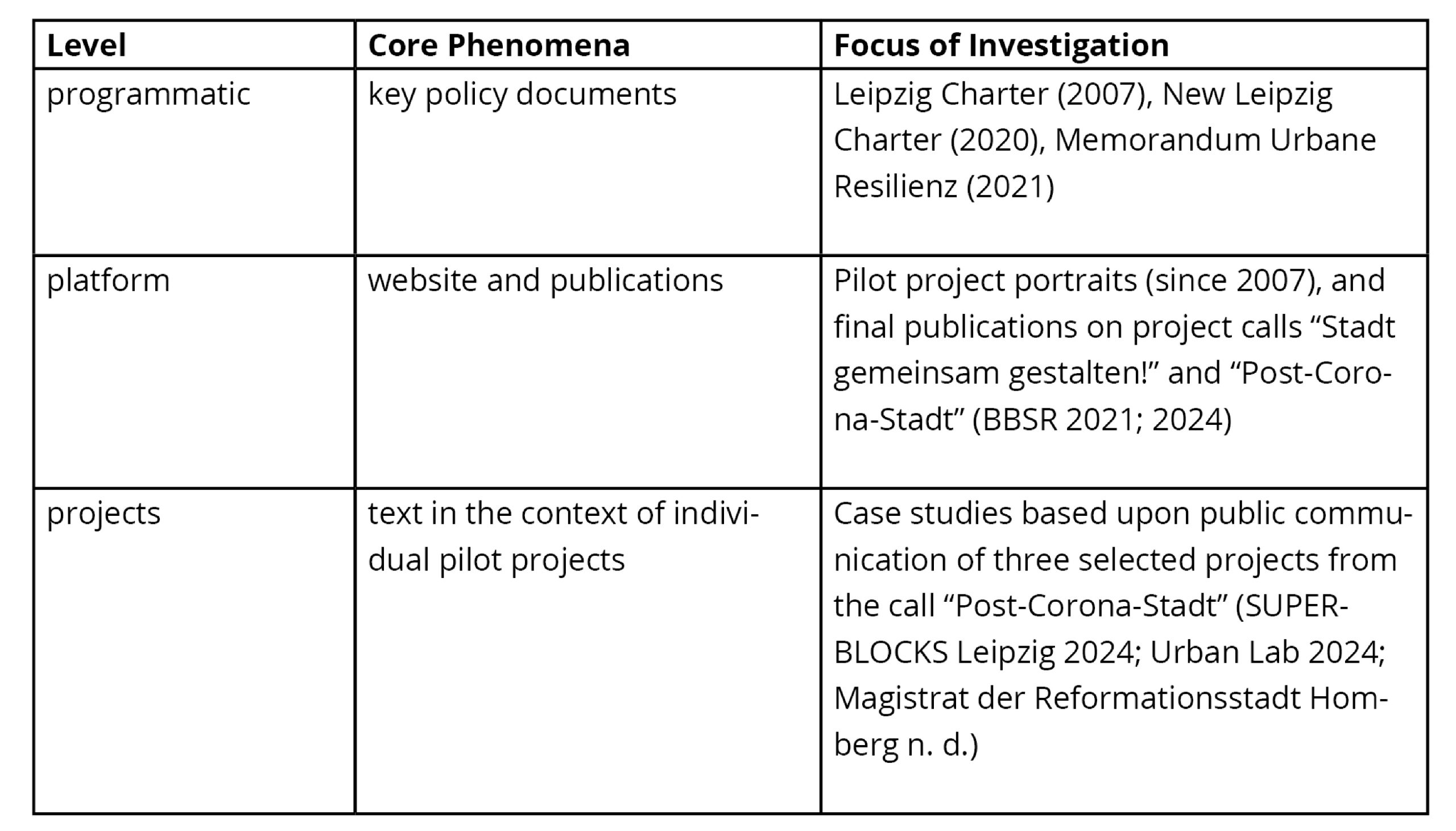
We conduct in-depth qualitative content analysis (Kuckartz 2018) of key documents from the programmatic and platform level. In this step, we focus on two project call final publications, namely on the explicitly resilience-centered call Post-Corona-Stadt (post-corona city) as well as the prior co-production-centered call Stadt gemeinsam gestalten! (shaping cities together) for comparison. Additionally, we conduct three case studies from newer NSP pilot projects from the resilience call, building on the interrelation of future visions and actor roles in narrative futures. For qualitative coding, we applied a coding scheme based upon the three dimensions elaborated above (Table 2).
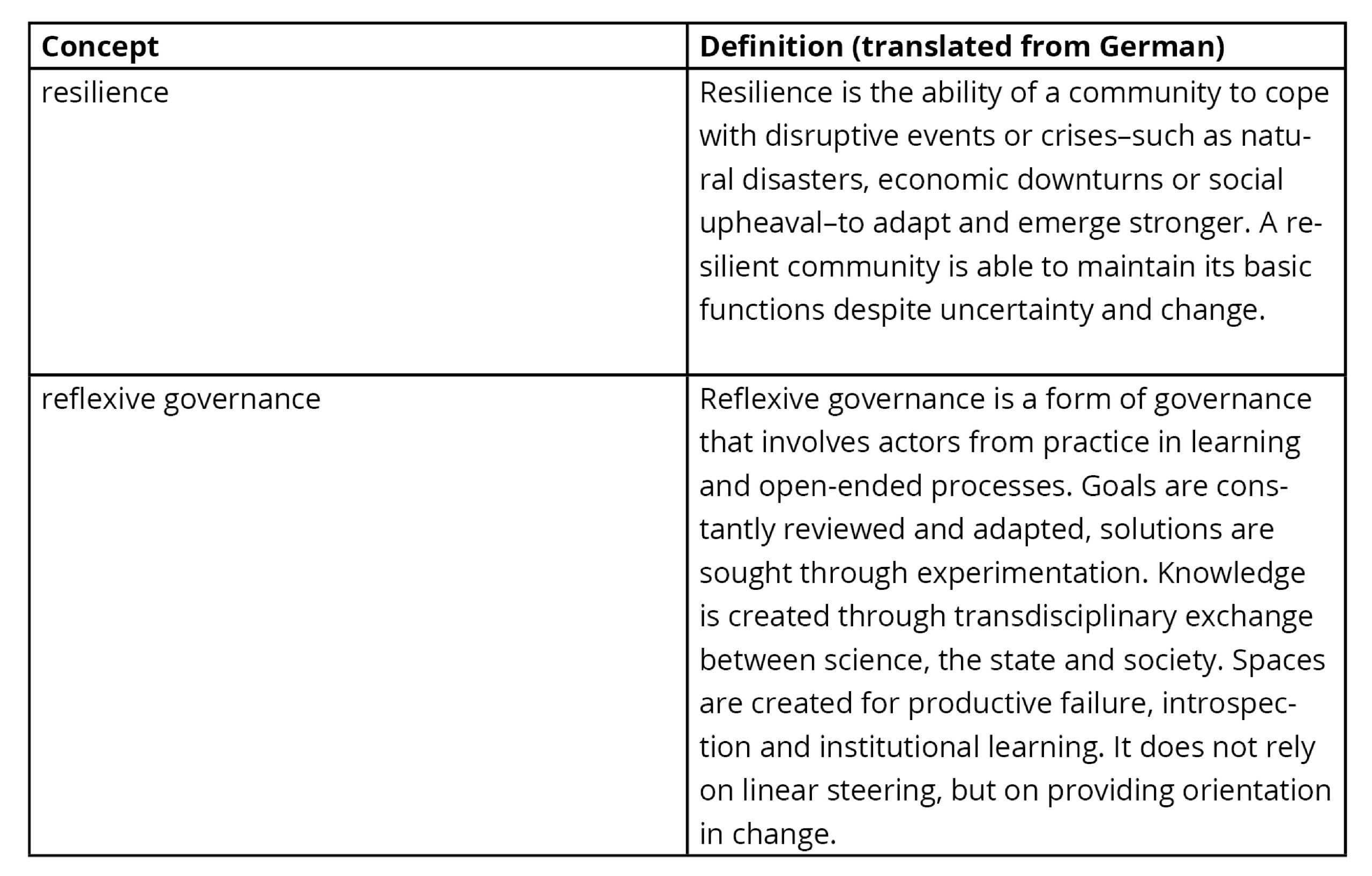
We combine this qualitative approach with quantitative analyses of NSP documents, including analysis of semantical textual similarity (STS) based upon embeddings (Matsui and Ferrara 2024) created by SBERT (Sentence-Bidirectional Encoder Representations from Transformers) neural networks which represent words and longer texts as vectors in a high-dimensional vector space (Devlin et al. 2019; Reimers and Gurevych 2019). STS analysis was conducted by calculating cosine similarity between paragraphs split from the original texts and concept exemplars based upon the definitions in the above sections (Table 3).
While the quantitative approach allows us to trace the representation and co-occurence of resilience and reflexive governance principles within NSP from a birds-eye perspective (effectively scaling up qualitative coding, see Odden et al. 2024), qualitative in-depth analysis sheds a light on how they are interlinked in concrete narratives, focusing on (1) how roles and responsibilities are assigned to different societal actors, (2) how the future and its relation to the present is represented and (3) how these two elements are woven together in the overall plot.
Bird’s Eye: The reflexive governance of urban resilience
Our analysis shows that in general, while reflexive governance principles have been a constant theme with little significant shifts over time, resilience has gained importance only recently. This is especially visible in the pilot project portraits which cover the whole timespan of the NSP since 2007 (see Figure 1). Importantly, we can diagnose a linkage between the two concepts, visible in a parallel rise in combined matches, that is paragraphs in which urban development is framed in the light of both concepts.
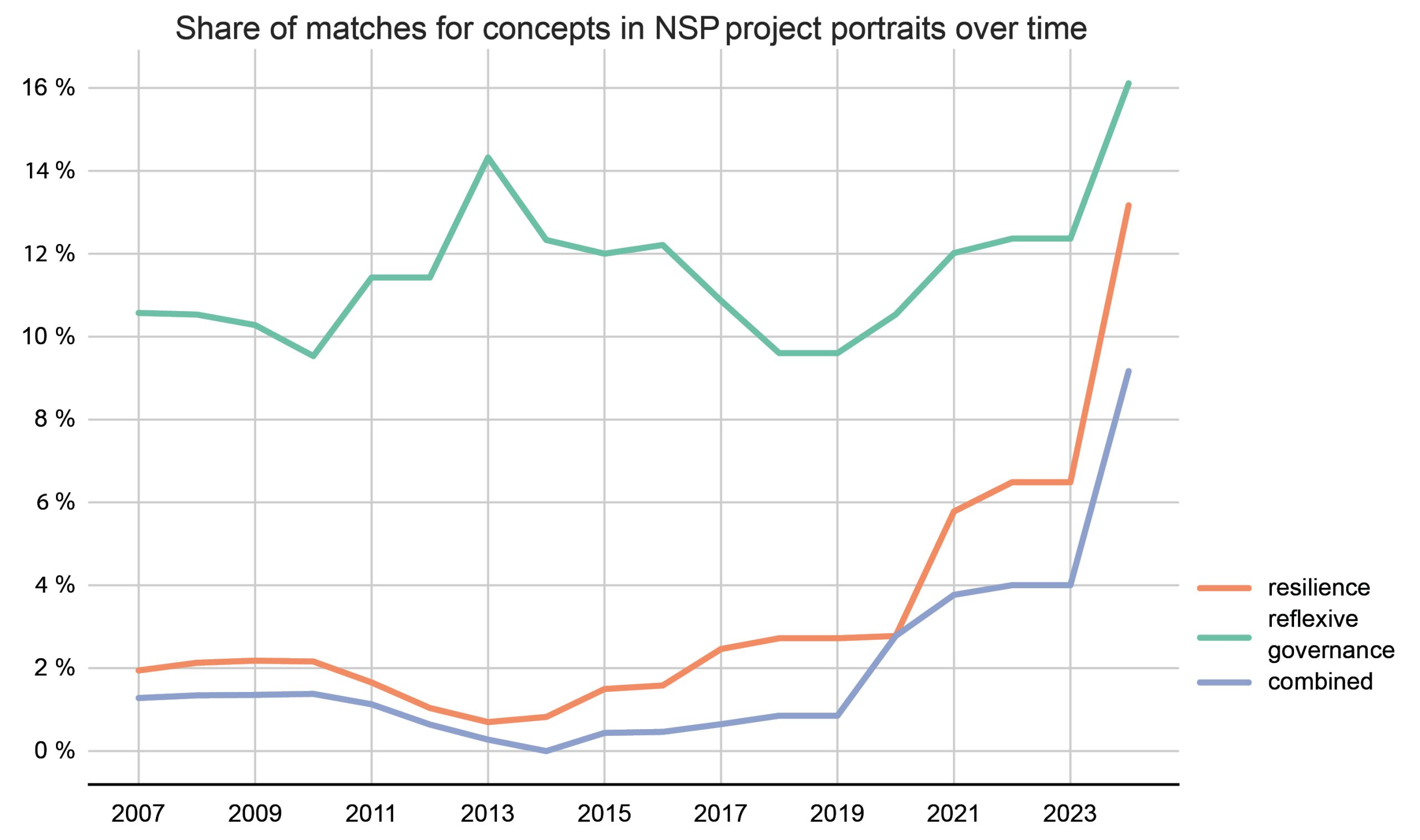
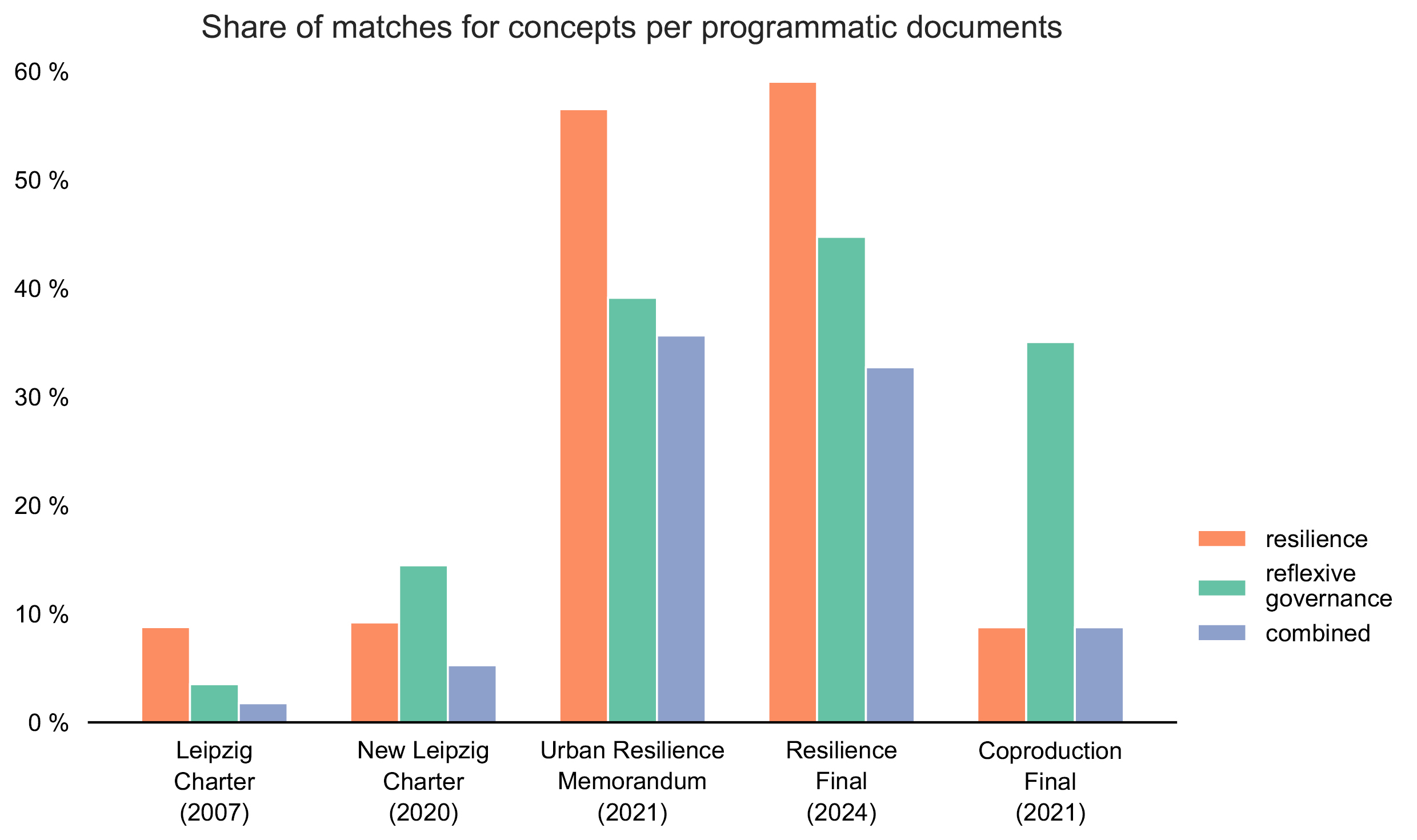
Looking at programmatic documents, we can see significant shifts between the original and new Leipzig charters, especially for reflexive governance principles which are represented more strongly. The resilience memorandum, however, introduces a much clearer focus, not only on its main theme – resilience, which is covered in more than half of the document’s paragraphs – but also on reflexive governance, which appears in close combination with resilience. Comparing this with the call final publications from the platform level, the co-production call’s clear focus on reflexive governance principles stands out, while the recent resilience call mirrors the memorandum’s emphasis on resilience with its tight linkage of both concepts (see Figure 2). We can observe a similar co-occurrence in project portraits, where matches for reflexive governance are much more frequent (approx. 12.5 percent of paragraphs) than for resilience (approx. 2.4 percent), and more than half of resilience matches are also reflexive governance matches.
In the following sections, we will explore how connections like these are established on a narrative level, by investigating both programmatic documents as well as self-representations of three pilot projects from the Post-Corona-Stadt call.
Deep Dive I: Narrative shifts on the programmatic and platform level
The general narrative of the original Leipzig Charter (2007) is about integrated urban development as a means to preserve and protect the qualities of the European City in the face of present and future challenges such as globalization and climate change. The future here appears as a direct prolongation of present challenges and existing positive qualities worth being protected. Utopian or apocalyptic notions are all but missing. The main protagonists of this narrative are political actors in the multi-level governance system: Municipal governments are the main actors on the ground, while national governments create frameworks to enable and strategically guide municipalities. Economic actors, civil society, science and the general public feature as allies, while state actors remain the central initiators and enablers. The narrative is state-centered and thus reflexive governance principles focus on integrating different departments and governance levels rather than integration of societal actors. For resilience, only traces can be found: There are hints in the discussion of structural challenges, but a general notion of crisis is all but missing.
In the New Leipzig Charter (2020), utopian as well as (post-)apocalyptic elements are present: Multiple crises have emerged and especially climate change is recognized as a realistic threat. At the same time, the charter paints a positive vision of the green, just and productive city that bears strong utopian elements. This vision is reachable by unlocking the transformative power of cities, a prefigurative quality already found in many European cities and in concrete experiments already building elements of a desirable future. These approaches bear strong resemblance to reflexive governance, with integrated urban development complemented by proactive and co-productive integration of a wide spectrum of societal actors and a stronger emphasis on learning approaches centered on networks and localized, on-the-ground experiments. Actor roles are shifting, with municipalities as the key protagonists and non-state actors identified as proactive allies joining and guided by municipalities. Resilience is not a central theme yet, but as present and future appear more prone to crisis, elements of coping with and shaping these developments become more pronounced.
The Memorandum Urbane Resilienz (2021) paints a post-apocalyptic picture where the present is already characterized by a multiplicity of crises that will only proliferate and escalate further. While the utopian green, just and productive city is still in reach, it now has to be protected by the resilient city that creates space for a good life in a world characterized by crises. Resilience is described as an ability to facilitate constant, pro-active transformation and is strongly linked to reflexive governance principles. A culture of participatory learning and co-production take center stage. Municipalities are still the main protagonists but the former focus on integrating departments and governance levels has developed into a broader organizing frame for multi-actor processes. Other elements of reflexive governance are also emphasized, such as iterative, adaptive processes, experiments, network learning and spaces for reflection. The memorandum emphasizes the development of capacities for transformation and finds many sources of this capacity already realized. Prefigurative futures emerge in integrated development concepts, local self-organization and the established spatial structures of many European Cities.
The final publication of the resilience pilot project call (2024) adopts the general framings of present and future as found in the memorandum: The present is characterized by structural challenges, existential crises and disruptive events that will only proliferate in the future. Resilient cities can be spaces in which positive and sustainable urban futures remain possible, if responsible actors embrace transformation as the new normal. Pilot projects take center stage, exemplifying a localized approach to how urban resilience should be governed and who is responsible to organize these processes as protagonists. Projects provide learning spaces for actors who can transfer their experiences to other contexts, exemplify how difficult discursive struggles can be solved and allow solutions to be experienced, increasing societal acceptance. Municipalities and civil society work hand in hand as protagonists of these projects and the projects themselves become important prefigurative elements as a kind of future bridgehead in the present.
Deep Dive II: Narrating resilient futures in three pilot projects
To investigate how urban resilience is narrated on the level of individual projects, we selected three sample projects from the Post-Corona-Stadt call. Our main focus was to achieve diversity in the core project focus (i. e. how to operationalize resilience on a local level). However, we also took into account the criteria of lead actors as well as city size (see Table 4). Looking at published texts only, we observe significant differences in the narratives told in the project’s contexts.
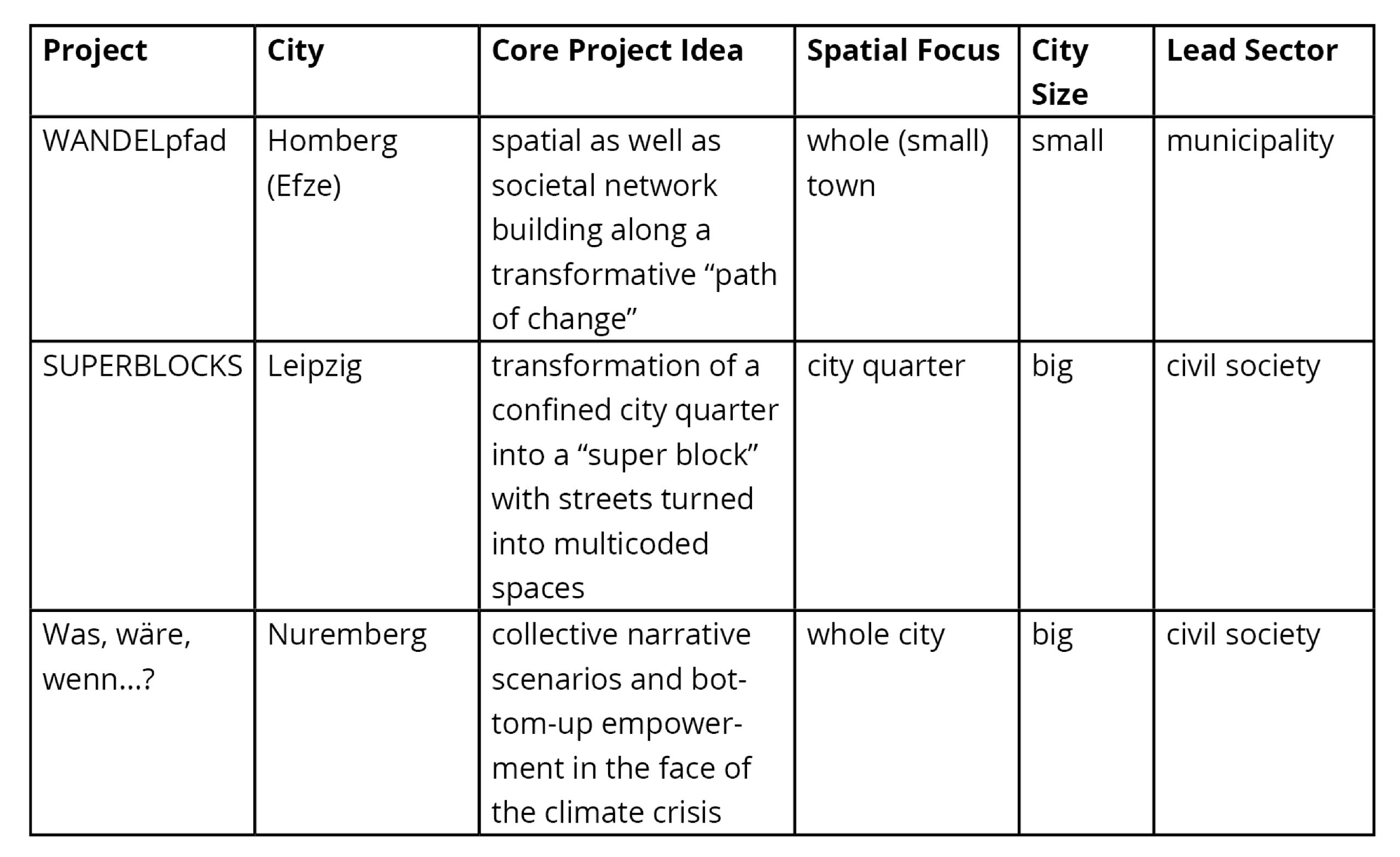
In Homberg (Efze), a small town situated in the German federal state of Hessen already struggling with structural change, the crisis is not a future prospect but a present reality (i. e. an overall post-apocalyptic framing). Followig the narrative, the central goal of the project is to create social and spatial structures which allow for a good and, ultimately, better life. The concrete measures taken in the project can be considered prefigurative building blocks of a better future. In this narrative, central protagonists are the municipality itself as well as local initiatives, generally actors with a capacity to invoke the transformative, place-based change the narrative is centered on. Places stricken by crisis become places for sustainable and future-proof practices, such as a furniture factory transformed into a housing project or a vacant store into a multi-coded place for social events. The WANDELpfad acts as a new polycentric spatial structure that cuts across existing routes, both spatially and conceptually.
Urban resilience emerges as a function of this new socio-spatial fabric as well as the city’s capacity to re-think and re-create itself.
In Homberg, reflexive governance is most visible in the strive to re-think the city itself, to not only preserve functions, but to adapt through transformation, and also in the activation of individual actors from diverse backgrounds that develop their own, place-based solutions.
In Leipzig, the crisis in question is the COVID pandemic which acts as a catalytic event for the narrative that not only creates real and present problems by disrupting everyday life in a specific city quarter, but also lays bare the structural deficits of its public spaces. The project’s goal is to reclaim public spaces dominated by car-based mobility by creating SUPERBLOCKS where social networks and practices on the neighborhood level can thrive.
New spatial structures and practices provide space for contributing to increasing resilience and enabling a good life in the face of the larger crisis of climate change.
While not outright utopian, the future aspired to is clearly healthier and more livable than the present, and existing superblocks in other cities (including Barcelona), act as prefigurative examples of this future. The narrative’s central protagonists are civil society actors who have experienced self-efficacy in predecessor projects. To invoke change, these actors have to win the municipality and the city quarter’s inhabitants as allies. Central elements of reflexive governance are present in the integrative, multi-actor approach advanced by an iterative combination of tactical urbanism and collective place-making as well as the general strive to reflect on existing problematic use of public space.
Finally, in Nuremberg, the narrative’s post-apocalyptic diagnosis is already in the project’s subtitle which claims that a city rehearses its own downfall in the wake of future extreme heat events. The central goal here is to engage with this fictional (but realistic) prospect and to not only collectively develop narratives of coping but also empower citizens to realize specific projects. Utopian elements are rare, but they shine through in the hope that while there will certainly be crises connected to water, heat and a deteriorating environment, a social crisis might yet be averted and society might find a new form of union.
Resilience arises as a result of a new mindset rooted in both shared stories and applied projects.
From this perspective, individual citizens’ projects can be considered humble prefigurative moments. In the Nuremberg narrative, the project’s lead actors play a more detached role than in the other two narratives, not acting as main protagonists, but as mentors – heralds of change, advisors and supporters who set citizens as the actual protagonists on track for their journey. Citizens start out as merely affected people and are then empowered to cope with the coming crisis as part of growing network and through concrete projects. Reflexive Governance, is realized mainly in collective knowledge generation and in creating a multiplicity of experimental approaches of coping.
Changing futures, changing narratives
Clearly, the overall framing of the future has changed significantly over time: While the 2007 charter paints a relatively stable future as a prolongation of a stable present, crises have moved closer to the presence in the 2020 charter. The Memorandum, published only one year later, but influenced heavily by the pandemic, paints a more drastic picture. These shifts are reflected in the narrative futures: In 2007, the objective was to preserve and propagate a successful model of urban development in a world that was no stranger to structural challenges, but still fundamentally stable. In 2021, there is an existential need to provide stability in a world already fundamentally riddled by crisis and this can only be achieved by embracing change and shifting into a mode of constant transformation. Still, the utopian outlook of the 2020 charter is not completely lost. Its main principles are re-interpreted in the light of an increasingly post-apocalyptic world: Transformation was already the main theme of the New Leipzig Charter, but it was an instrument to realize a desirable future state. Now this desired future – a green, just and productive city – becomes a fluid thing that must be constantly re-negotiated with an unstable world, and transformation the new normal. Resilience then, is the ability of a city to constantly and pro-actively adapt and thus transform itself.
Actor roles within the narratives change as well: In the first Leipzig Charter, national governments play a central role in steering all state actors towards the ideal of integrated urban development, championing the concept and creating the structures to enact it. In the second charter, municipalities take center stage. The transformative power is located in specific cities, while actors on other levels play more supporting roles. With the resilience memorandum, this centrality does not change fundamentally. Importantly, and perhaps not surprisingly, in all policy documents, state actors remain the main protagonists. Among allies, however, civil society gains while the private economic sector somewhat loses prominence. This change relates to a rising awareness for neighborhoods and city quarters as places for co-production and social cohesion which gain importance both in the notion of the just city (New Leipzig Charter) as well as the care for especially vulnerable groups (Memorandum). We also find a shift in the spatial focus: While the 2007 charter is about implementing integrative urban development across all cities, the 2020 charter directly addresses individual cities as the settings of transformative processes. The memorandum goes one step further and (partly) moves the focus of change from cities as places into the municipalities as actors.
Resilience as a vision, resilience as a policy
Narratives in the final publication of the resilience call become more concrete, both in focusing on neighborhoods within cities, and on the concrete realization of abstract principles. Concrete projects appear as prefigurative elements in which the future we want is already realized, and which are therefore deemed transformative. Municipalities are no longer the only protagonists and can only act effectively in tandem with civil society. Projects are co-productive, jointly realized by state and non-state actors, and only in being co-productive can they foster resilience in their wider city contexts. Narratives from the case studies exemplify the translation of abstract policy principles into specific contexts in at least two dimension: local urban spaces with their specific history and socio-spatial structures (on different relevant aspects, see Bögel et al. 2022) as well as the actor constellations behind the projects with their own specific histories, capacities for action and relations towards their wider local context. Along these lines, narratives focus on specific aspects of both resilience (e. g. the kind of stressors engaged with or the aspects of robustness, adaptivity etc. aimed for) and reflexive governance principles vary, as projects explore only certain aspects in their quest to solve specific localized problems. These specific realizations can be read as expressions of local peculiarities discussed by concepts like Eigenart (intrinsic logic, see WBGU 2016; Löw 2012) which shed a light on local contexts as both constraints and resources for processes of urban development and social change. Consequently, local context cannot easily be abstracted away to reveal generalizable narratives of change. On the contrary, the local realization must be acknowledged as a constitutive element, which is exactly what the programmatic narratives of NSP argue for.
Still, the projects do reveal certain commonalities, one of which is the central role of individual citizens and their interrelations as the core fabric of urban resilience. On this individual level now clearly visible in project narratives, the distinction between actor roles becomes fluid. As told most clearly in the Leipzig narrative, the transition from being merely affected to becoming an empowered protagonist is a key to individual resilience, and this shift mirrors the development of transformative capacities on the level of cities. At the same time, the connection between municipality and civil society as core protagonists becomes more of a normative ideal: While the municipality is a central actor in the Homberg narrative (where it is also the project lead), in Leipzig it joins only at a later point in the narrative, but not without introducing tensions. Lastly, in Nuremberg, it is largely absent, but still, civil society actors call on municipalities to follow their example. Finally, from a plot perspective, perhaps the most striking commonality is the need for crisis as the inciting incident of a story: In Homberg, there is the fallout of structural change, in Leipzig, there is the Covid pandemic, and in Nuremberg, where there is no tangible crisis yet, a future one is pulled into the present by means of collective foresight.
Narratives of crisis and transformation
As evident from the bird’s eye investigation, the linkages explored in the deep dives exemplify a deeper narrative: Urban resilience in the NSP is really about developing transformative capacities on the ground by adopting a new planning culture rooted in reflexive governance principles. Since the NSP has taken up resilience and reflexivity as guiding principles, this diagnosis might not come as a surprise. However, the proposed principles of governing urban resilience (such as co-production, processual and place-based thinking, experimentation and network learning) already became part of the NSP’s policy core during the thirteen years between the two Leipzig charters. They are not simply adopted from the resilience discourse but have long been a constitutive element of the NSP down to its institutional structure. The current quest for resilience might indeed have opened a window of opportunity for a policy idea of reflexivity and transformation whose time has come in the wake of the COVID pandemic.
However, the narrative linkages found here are but one possible instantiation of what resilience might mean in the urban context. Our findings are in striking difference to more general studies which observe that in discourses of sustainable and urban futures, the motive of crisis and also resilience has often been associated with a shift towards securitization or control, and, importantly, related to anti-liberal and anti-egalitarian elements (Adloff and Neckel 2019; Zeiderman and Dawson 2022). These contrast starkly with the reflexive governance principles investigated in this paper. From this perspective, what is most surprising are the utopian elements that are introduced into the resilience narratives in the context of the NSP. Here, actors do not simply react to and manage crises but also develop far-reaching and positive visions that can not only be considered functionally superior to incumbent practices (because they are more resilient to acute and chronic stressors) but also preferable from a normative and quality-of-life perspective (because they are more just and open up new spaces for a good life for all). As the exemplary cases of Homberg and Leipzig show, locally specific translations are also expressions of positive agency and a pro-active appropriation of the new urban resilience agenda by local actors.
We hope the results of our study may foster reflection among practitioners in policy and planning about narrative interlinkages between different spatial and administrative levels as well as the agency of local actors. Focusing on the NSP and its pilot projects, we have investigated but a narrow slice of the German planning discourse. Still, our results shed a light on how abstract concepts like urban resilience are translated into and out of local contexts where learning about their application takes place. The NSP aspires to be a catalyst for this translation process and explicitly taps into local agency as part of reflexive governance. While an assessment of its broader transformative impact is outside the scope of our analysis, we do find that urban development policy in the context of the NSP is not lost in post-apocalyptic narratives of coping but retains the original utopian character of the New Leipzig Charter even in the face of crisis.
References
Adger, W. Neil (2000): Social and ecological resilience: are they related? In: Progress in Human Geography, 24 (3), 347–364, DOI: 10.1191/030913200701540465.
Adloff, Frank and Neckel, Sighard (2019): Modernisierung, Transformation oder Kontrolle? Die Zukünfte der Nachhaltigkeit. In: Dörre, Klaus; Rosa, Hartmut; Becker, Karina; Bose, Sophie and Seyd, Benjamin (Eds.): Große Transformation? Zur Zukunft moderner Gesellschaften. Wiesbaden: Springer Fachmedien, 167–180.
BBSR (Bundesinstitut für Bau-, Stadt- und Raumforschung) (Ed.) (2013): Informationen zur Raumentwicklung. Themenheft Resilienz. Bonn: BBSR.
BBSR (Bundesinstitut für Bau-, Stadt- und Raumforschung) (Ed.) (2021): Stadt gemeinsam gestalten! Neue Modelle der Koproduktion im Quartier. Nationale Stadtentwicklungspolitik. Bonn: BBSR.
BBSR (Bundesinstitut für Bau-, Stadt- und Raumforschung) (Ed.) (2024): Urbane Resilienz in der Praxis. Impulse für die Stadt im Wandel. Bonn: BBSR.
Beck, Ulrich; Giddens, Anthony and Lash, Scott (1994): Reflexive Modernization. Politics, Tradition and Aesthetics in the Modern Social Order. Stanford: Stanford University Press.
Beckmann, Klaus J. (2018): Integrierte Stadtentwicklung. In: ARL (Akademie für Raumforschung und Landesplanung) (Ed.): Handwörterbuch der Stadt- und Raumentwicklung. Hannover: ARL.
Béné, Christophe; Mehta, Lyla; McGranahan, Gordon; Cannon, Terry; Gupte, Jaideep and Tanner, Thomas (2018): Resilience as a Policy Narrative. Potentials and Limits in the Context of Urban Planning. In: Climate and Development 10 (2), 116–133. DOI: 10.1080/17565529.2017 .1301868.
BMI (Bundesministerium des Inneren und für Heimat) (Ed.) (2020): NEUE LEIPZIG CHARTA. Die transformative Kraft der Städte für das Gemeinwohl. Berlin: BMI.
BMI (Bundesministerium des Inneren, für Bau und Heimat) (Ed.) (2021): Memorandum Urbane Resilienz. Wege zur robusten, adaptiven und zukunftsfähigen Stadt. Berlin: BMI.
BMVBS (Bundesministerium für Verkehr, Bau und Stadtentwicklung) (2009): Stadtentwicklungsbericht 2008. Neue urbane Lebens- und Handlungsräume. Berlin, Bonn: BMVBS.
Bögel, Paula Maria; Augenstein, Karoline; Levin-Keitel, Meike and Upham, Paul (2022): An Interdisciplinary Perspective on Scaling in Transitions. Connecting Actors and Space. In: Environmental Innovation and Societal Transitions 42, 170–183. DOI: 10.1016/j. eist.2021.12.009.
Bundesregierung (2008): Deutsche Anpassungsstrategie an den Klimawandel. Vom Bundeskabinett am 17. Dezember 2008 beschlossen.
Cassegård, Carl and Thörn, Håkan (2018): Toward a Postapocalyptic Environmentalism? Responses to Loss and Visions of the Future in Climate Activism. In: Environment and Planning E: Nature and Space 1 (4), 561–578. DOI: 10.1177/2514848618793331.
Cinner, Joshua E. and Barnes, Michele L. (2019): Social Dimensions of Resilience in Social- Ecological Systems. In: One Earth 1 (1), 51–56. DOI: 10.1016/j.oneear.2019.08.003.
De Moor, Joost (2022): Postapocalyptic Narratives in Climate Activism. Their Place and Impact in Five European cities. In: Environmental Politics 31 (6), 927–948. DOI: 10.1080/09644016.2021.1959123.
Devlin, Jacob; Chang, Ming-Wie; Lee, Kenton and Toutanova, Kristina (2019): BERT. Pre-training of Deep Bidirectional Transformers for Language Understanding. In: Association for Computational Linguistics (Ed.): Proceedings of the 2019 Conference of the North American Chapter of the Association for Computational Linguistics. Human Language Technologies. Minneapolis, 4171–4186. DOI: 10.18653/v1/N19-1423.
Di Giulio, Antonietta and Defila, Rico (2023): Narrative als Ansatz zur Förderung von Nachhaltigkeit. In: Ökologisches Wirtschaften 1 (38), 30–35. DOI: 10.14512/OEW380130.
Feindt, Peter H. and Weiland, Sabine (2018): Reflexive Governance. Exploring the Concept and Assessing Its Critical Potential for Sustainable Development. Introduction to the Special Issue. In: Journal of Environmental Policy & Planning 20 (6), 661–674. DOI: 10.1080/1523908X.2018.1532562.
Fischer, Daniel, Fücker, Sonja, Selm, Hanna, Storksdieck, Martin and Sundermann, Anna (2022): SusTelling. Storytelling for Sustainability. In: Narrating Sustainability through Storytelling. London: Routledge, 13–25.
Folke, Carl; Carpenter, Stephen R.; Walker, Brian; Scheffer, Marten; Chapin, Terry and Rockström, Johan (2010): Resilience Thinking. Integrating Resilience, Adaptability and Transformability. In: Ecology and Society 15 (4), 20.
Friberg, Anna (2022): Disrupting the Present and Opening the Future. In: Utopian Studies 33 (1), 1–17. DOI: 10.5325/utopianstudies.33.1.0001.
Gadinger, Frank, Jarzebski, Sebastian and Yildiz, Taylan (Eds.) (2014): Politische Narrative: Konzepte – Analysen – Forschungspraxis. Wiesbaden: Springer VS.
Göddecke-Stellmann, Jürgen (2018): Städtebauförderung. In: ARL (Akademie für Raumforschung und Landesplanung) (Ed.): Handwörterbuch der Stadt- und Raumentwicklung. Hannover: ARL, 2391–2401.
Godschalk, David R. (2003): Urban Hazard Mitigation. Creating Resilient Cities. In: Natural Hazards Review 4 (3), 136–143. DOI: 10.1061/(ASCE)1527-6988(2003)4:3(136).
Greiving, Stefan (2018): Resilienz/Robustheit. In: Akademie für Raumforschung und Landesplanung (Ed.): Handwörterbuch der Stadt- und Raumentwicklung. Hannover: ARL – Akademie für Raumforschung und Landesplanung, 2063–2072.
Hatzfeld, Ulrich and Jakubowski, Peter (2008): Nationale Stadtentwicklungspolitik in Deutschland — zwischen Versuch und Vision. In: Raumforschung und Raumordnung | Spatial Research and Planning 66 (2), 130–138. DOI: 10.1007/BF03183123.
Healey, Patsy (2004): Creativity and Urban Governance. In: Policy Studies 25 (2), 87–102. DOI: 10.1080/0144287042000262189.
Holling, C. S. (1973): Resilience and Stability of Ecological Systems. In: Annual Review of Ecology and Systematics 4 (1), 1–23. DOI: 10.1146/annurev.es.04.110173.000245.
Informelles Ministertreffen zur Stadtentwicklung (2007): LEIPZIG CHARTA zur nachhaltigen europäischen Stadt. Angenommen anlässlich des Informellen Ministertreffens zur Stadtentwicklung und zum territorialen Zusammenhalt in Leipzig am 24. / 25. Mai 2007.
Jabareen, Yosef (2013): Planning the Resilient City. Concepts and Strategies for Coping with Climate Change and Environmental Risk. In: Cities 31 (4), 220–229. DOI: 10.1016/j. cities.2012.05.004.
Jakubowski, Peter (2013): Resilienz – eine zusätzliche Denkfigur für gute Stadtentwicklung. In: Informationen zur Raumentwicklung 4.2013, 371–378.
Kuckartz, Udo (2018): Qualitative Inhaltsanalyse: Methoden, Praxis, Computerunterstützung. Grundlagentexte Methoden. Weinheim, Basel: Beltz Juventa.
Leipold, Sina et al. (2023). Lessons, Narratives, and Research Directions for a Sustainable Circular Economy. In: Journal of Industrial Ecology 27 (1), 6–18. DOI: 10.1111/jiec.13346.
Löw, Martina (2012): The Intrinsic Logic of Cities: Towards a New Theory on Urbanism. In: Urban Research & Practice 5 (3), 303–315. DOI: 10.1080/17535069.2012.727545.
Magistrat der Reformationsstadt Homberg (n. d.): WANDELpfad Homberg. https://wandelpfad-homberg.de/, Accessed: 03.06.2025.
Matsui, Akira and Ferrara, Emilio (2024): Word Embedding for Social Sciences: An Interdisciplinary Survey. In: PeerJ Computer Science 10, e2562. DOI: 10.7717/peerj-cs.2562.
Monteiro, Ana; Carvalho, Vânia; Velho, Sara and Sousa, Carlos (2012): Assessing and Monitoring Urban Resilience Using COPD in Porto. In: Science of The Total Environment 414, 113–19. DOI: 10.1016/j.scitotenv.2011.11.009.
Müller, Bernhard (Ed.) (2011): German Annual of Spatial Research and Policy 2010. Urban Regional Resilience: How Do Cities and Regions Deal with Change? Berlin, Heidelberg: Springer Berlin Heidelberg, German Annual of Spatial Research and Policy. DOI: 10.1007/978-3-642-12785-4.
Odden, Tor Ole B.; Tyseng, Halvor; Timmann Mjaaland, Jonas; Kreutzer, Markus Fleten and Malthe-Sørenssen, Anders (2024): Using Text Embeddings for Deductive Qualitative Research at Scale in Physics Education. In: Physical Review Physics Education Research 20 (2): 020151. DOI: 10.1103/PhysRevPhysEducRes.20.020151.
Patterson, James; Schulz, Karsten; Vervoort, Joost; Van Der Hel, Sandra; Widerberg, Oscar; Adler, Carolina; Hurlbert, Margot; Anderton, Karen; Sethi, Mahendra and Barau, Aliyu (2017): Exploring the Governance and Politics of Transformations towards Sustainability. In: Environmental Innovation and Societal Transitions 24, 1–16. DOI: 10.1016/j. eist.2016.09.001.
Reimers, Nils and Gurevych, Iryna (2019): Sentence-BERT: Sentence Embeddings using Siamese BERT-Networks. In: Association for Computational Linguistics (Ed.): Proceedings of the 2019 Conference on Empirical Methods in Natural Language Processing and the 9th International Joint Conference on Natural Language Processing. Hong Kong, 3982–3992. DOI: 10.18653/v1/D19-1410.
Scholes, Robert (1981): Afterthoughts on Narrative. In: Critical Inquiry, 66, 205–212. DOI: 10.1086/448096.
Simoens, Machteld Catherina; Fuenfschilling, Lea and Leipold, Sina (2022): Discursive Dynamics and Lock-Ins in Socio-Technical Systems. An Overview and a Way Forward. In: Sustainability Science 17 (5): 1841–1853. DOI: 10.1007/s11625-022-01110-5.
Smith, Adrian (2007): Translating sustainabilities between green niches and socio-technical regimes. In: Technology Analysis & Strategic Management, 19 (4), 427-450. DOI: 10.1080/09537320701403334.
Smith, Adrian and Raven, Rob (2012): What is protective space? Reconsidering niches in transitions to sustainability. In: Research Policy, 41 (6), 1025-1036. DOI: 10.1016/j.respol.2011.12.012.
SUPERBLOCKS Leipzig (Ed.) (2024): Auf die Straße, fertig los! Impulse für mehr urbane Praxis. Leipzig: SUPERBLOCKS Leipzig.
UNGA (United Nations General Assembly) (2015): Transforming our World. The 2030 Agenda for Sustainable Development. Resolution Adopted by the General Assembly. A/ RES/70/1. New York: UNGA.
Urban Lab (Ed.) (2024): Was wäre, wenn...? Gemeinsam für eine klimaresiliente Stadt. Nürnberg: Urban Lab.
Voß, Jan-Peter; Bauknecht, Dierk and Kemp, René (Eds.) (2006): Reflexive Governance for Sustainable Development. Cheltenham: Edward Elgar.
Voß, Jan-Peter and Kemp, René (2006): Sustainability and Reflexive Governance. Introduction. In: Voß, Jan-Peter et al. 2006 (Eds.): Reflexive Governance for Sustainable Development, 3–28.
Voß, Jan-Peter and Loorbach, Derk (2006): Transition Management. A Reflexive Governance Approach. In: Voß, Jan-Peter et al. 2006 (Eds.): Reflexive Governance for Sustainable Development, 103–130.
WBGU (German Advisory Council on Global Change) (2016): Humanity on the Move. Unlocking the Transformative Power of Cities. Berlin: WBGU.
WBGU (German Advisory Council on Global Change) (2011): World in Transition. A Social Contract for Sustainability. Berlin: WBGU.
Weigel, Oliver (2021): Die Neue Leipzig-Charta – von der Strategie zur Umsetzung. In: vhw FWS 2 März-April 2021, 97–100.
Wittmayer, Julia. M.; Backhaus, Julia; Avelino, Flor; Pel, Bonno; Strasser, Tim; Kunze, Iris and Zuijderwijk, Linda (2019): Narratives of Change: How Social Innovation Initiatives Construct Societal Transformation. In: Futures 112: 102433.
Zeiderman, Austin and Dawson, Katherine (2022): Urban Futures. Idealization, Capitalization, Securitization. In: City 26 (2–3), 261–80. DOI: 10.1080/13604813.2022.2035964.